Last Update: August 2026
Understanding AI Hallucinations: Why AI Gives Wrong Answers
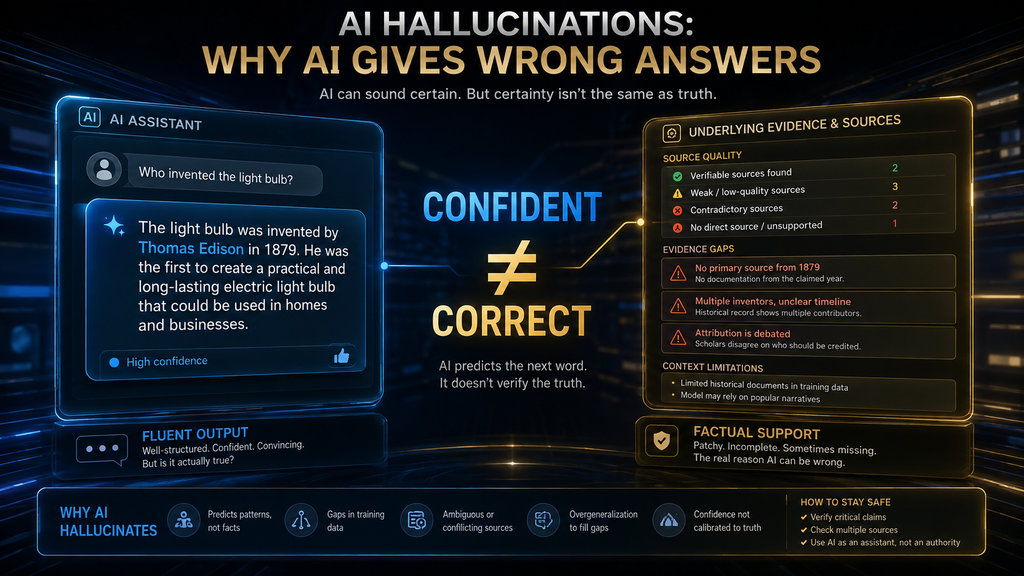
AI can write a convincing explanation about a topic you barely understand. That is one of its strengths. It is also one of its biggest risks.
The problem with an AI hallucination isn’t simply that the answer is wrong. Search engines, databases and traditional software can also return incorrect information.
The more dangerous characteristic is this:
AI can produce an incorrect answer that looks finished, coherent and confident.
OpenAI’s published research defines hallucinations as plausible but false statements generated by language models and argues that standard training and evaluation procedures can reward guessing instead of appropriately expressing uncertainty. That creates a strange reliability problem. A human who says:
“I don’t know.”
hasn’t solved your problem. But at least they haven’t invented an answer. An AI system that says:
“The answer is X”
when it has insufficient evidence may appear far more useful than it actually is. And this becomes more consequential as AI moves into:
- research,
- customer support,
- software development,
- finance,
- healthcare,
- education,
- legal work,
- internal business operations.
So understanding hallucinations isn’t about becoming afraid of AI. It is about learning when an AI answer is likely to be reliable, when uncertainty is high, and when verification becomes mandatory.
What Is an AI Hallucination?
An AI hallucination is an output that contains information that is false, unsupported, fabricated, or inconsistent with the available evidence, while being presented as a plausible response.
OpenAI describes hallucinations as cases where a model confidently generates an answer that isn’t true. The 2026 Nature paper similarly describes hallucinations as confident, plausible falsehoods and examines why modern models can continue producing them even as they become more capable.
A hallucination can look like:
- a fabricated fact
- an invented person
- a nonexistent study
- a fake citation
- an incorrect number
- a wrong date
- a made-up quotation
- a false product feature
- an incorrect interpretation of a document
- a plausible but unsupported explanation.
And there is another important distinction.
Not every AI error is the same
Suppose you ask an AI to calculate:
487 × 39
and it returns the wrong answer. That’s an error. But if you ask:
What was the title of a very obscure paper published in 1997?
and the AI confidently gives you a convincing but nonexistent paper title and DOI, that’s a much more classic hallucination pattern. The difference matters because the cause and mitigation can differ.
Why Does AI Hallucinate?
There isn’t one single cause. A useful mental model is: Training → → Prediction → → Missing / ambiguous evidence → → Generation pressure → → Plausible completion → → Possible hallucination. The important part is that AI models are built to generate useful-looking outputs from learned patterns.
That is enormously powerful. But it creates a fundamental challenge when the requested information is:
- rare,
- ambiguous,
- poorly represented,
- unavailable,
- outdated,
- conflicting,
- or impossible to determine.
The Next-Token Explanation Is Useful—but Incomplete
You may have heard:
“AI hallucinates because it predicts the next word.”
That’s directionally useful, but it is too simplistic for a serious explanation. During pretraining, language models learn patterns by predicting the next token in large amounts of text. That works extremely well for patterns that appear repeatedly.
Grammar is highly patterned. Common phrases are highly patterned. Normal sentence structure is highly patterned.
But consider a one-off factual detail such as:
- the exact birthday of an obscure person,
- the precise title of a forgotten paper,
- a niche historical event,
- a low-frequency product specification.
There may not be enough repeated statistical evidence for the model to reliably reconstruct the exact fact. OpenAI’s research uses this distinction to explain why arbitrary low-frequency facts can be much more difficult for language models than highly regular patterns such as spelling and grammar. The 2026 Nature paper develops the argument further, showing that next-token prediction creates statistical pressure toward hallucination even under idealized conditions, because some facts simply don’t have the same predictable structure as regular language patterns.
So the deeper explanation is:
Language models are extremely good at generating probable continuations. Probability is not identical to truth.
That distinction is foundational.
The Bigger Problem: AI Is Often Rewarded for Answering
Here is one of the most important findings from current hallucination research. Imagine a student who gets:
- 1 point for a correct answer
- 0 points for “I don’t know”
- 0 points for a wrong answer
If the student has a 20% chance of knowing the answer and a 10% chance of guessing correctly, guessing may look better than admitting uncertainty. A similar incentive can exist in AI evaluation.
The 2026 Nature paper argues that many widely used accuracy-based evaluations treat abstention as failure and therefore reward models for guessing. The researchers found that hallucination-reduction techniques can decrease errors while also lowering headline accuracy under conventional scoring, creating an adoption problem.
OpenAI’s own research makes the same point and gives a concrete illustration: in its comparison on SimpleQA, one model achieved slightly higher accuracy while producing dramatically more errors because it answered far more questions instead of abstaining.
Why this matters
The reliable answer isn’t always:
“Here is my best guess.”
Sometimes the most useful answer is:
“I don’t have enough information to answer that confidently.”
That is abstention. And abstention is a feature of reliability, not a failure of intelligence.
Why AI Sounds So Confident When It’s Wrong
This is where users get misled. Humans often associate:
- fluent language,
- complete sentences,
- confident tone,
- detailed explanations
with knowledge. AI can reproduce all four without possessing reliable evidence for the underlying claim.
An incorrect answer might therefore look more convincing than a correct but incomplete answer. Consider these two outputs.
Response A
“I don’t have enough evidence to verify the exact publication date.”
Response B
“The paper was published on March 14, 1998, by the International Journal of Computational Systems, Volume 7, Issue 2.”
Response B feels more authoritative. It has:
- a date,
- a journal,
- a volume,
- an issue.
But those extra details are precisely what should make you ask:
Where did those details come from?
Specificity is not evidence. Fluency is not evidence. Confidence is not evidence.
A citation is not automatically evidence either. The evidence itself has to be checked.
The AI Hallucination Types You Actually Need to Recognize
A single “AI is sometimes wrong” warning is not enough. You need to recognize the different ways hallucinations can appear.
1. Factual Hallucination
The AI states a fact that is simply false. Example:
“Company X was founded in 1998.”
when the company was actually founded in 2004. This can be especially difficult to detect when the surrounding explanation is accurate.
2. Citation Hallucination
The AI provides:
- fake citations,
- nonexistent papers,
- invented DOIs,
- fake URLs,
- real authors attached to the wrong paper.
This is particularly dangerous in research and academic workflows. A citation can look convincing enough that a reader never checks it.
3. Entity Hallucination
The AI invents:
- companies,
- people,
- products,
- organizations,
- events,
- books,
- publications.
This often happens around obscure or low-frequency subjects.
4. Numerical Hallucination
The model gives the wrong:
- percentage,
- price,
- date,
- quantity,
- financial figure,
- statistic,
- calculation.
Numbers create a dangerous illusion of precision.
“47.2%”
looks more authoritative than:
“A significant portion.”
But the precision may be completely fabricated.
5. Temporal Hallucination
The AI presents old information as current. This matters for:
- prices,
- product features,
- software versions,
- policies,
- regulations,
- company leadership,
- market conditions.
A fact can be historically correct and still be wrong for today’s decision.
6. Source-Grounding Failure
The AI receives a document but misrepresents what the document actually says. For example, the source states:
“The product may support feature X.”
The model writes:
“The product supports feature X.”
That sounds like a tiny difference. Operationally, it’s enormous.
7. Instruction / Execution Failure
The model has the necessary information but performs the task incorrectly. For example:
- misreads a spreadsheet,
- changes a number,
- omits a requirement,
- misunderstands a clause,
- applies the wrong transformation.
Not every reliability failure comes from missing knowledge. Sometimes the knowledge is present and the execution is wrong.
Where Are Hallucinations Most Likely?
Risk tends to increase when the task contains one or more of these conditions.
Rare Information
The fact is obscure or appears infrequently.
Missing Information
The model does not have enough evidence.
Current Information
The answer changes over time.
Ambiguous Questions
The question permits multiple interpretations.
Hidden Assumptions
The user expects the AI to know unstated context.
Complex Documents
There are many pieces of information to reconcile.
High Specificity
The question asks for exact names, dates, numbers or citations.
No Verification Layer
Nothing checks the answer before it becomes an action. That last factor is especially important. A hallucination sitting inside an experimental brainstorming session is different from a hallucination automatically entered into a customer-facing system.
The Hallucination Risk Ladder
Not every hallucination deserves the same response. Here’s the framework to use.
Level 1 — Cosmetic Error
Minor mistake with little consequence. Example: A typo in a low-stakes draft. Response: Correct and continue.
Level 2 — Factual Error
Incorrect information that affects understanding. Example: Wrong publication date. Response: Verify before publishing.
Level 3 — Evidence Failure
Fabricated citation, unsupported claim or incorrect interpretation of a source. Example: A research article that doesn’t exist. Response: Stop and verify the evidence.
Level 4 — Decision Error
Incorrect information could materially affect a business, financial, academic or operational decision. Response: Independent verification becomes mandatory.
Level 5 — Consequential Harm
The output could contribute to serious medical, legal, security, financial or safety harm.
Response: AI should not be treated as the final authority. Human expertise and authoritative evidence must control the decision.
This is one of the most important distinctions in the entire topic:
Risk depends on consequence, not only probability.
A 5% chance of an incorrect movie date is irrelevant compared with a 5% chance of an incorrect medication instruction.

Why Bigger and Smarter Models Still Hallucinate
A common assumption is:
“Once models become smart enough, hallucinations will disappear.”
The evidence doesn’t support that simple conclusion. Modern frontier models can have substantially lower hallucination rates than earlier systems.
But current research shows that hallucination remains a fundamental reliability problem. OpenAI explicitly says hallucinations remain a challenge even as models become more capable, while the 2026 Nature paper argues that improved capability alone doesn’t solve the underlying incentive and uncertainty problem.
There is an important reason. Some questions are inherently unanswerable. For example:
What was the private conversation between two people yesterday?
A more capable model doesn’t suddenly gain access to information that doesn’t exist in its available evidence. The right behavior is:
“I don’t know.”
Not:
“Here is a plausible answer.”
That is why reliability requires calibration, not just intelligence.
The AI Reliability Stack
A trustworthy AI answer should ideally pass through five layers.
1. SOURCE
Is the underlying information trustworthy? If the source is wrong, the rest of the pipeline starts with bad evidence.
2. GROUNDING
Does the model have access to the relevant evidence? This might come from:
- provided documents,
- databases,
- retrieval,
- search,
- APIs,
- structured data.
↓
3. REASONING
Did the model interpret the evidence correctly? The model can retrieve the correct document and still misunderstand it.
4. VERIFICATION
Was the important claim independently checked? This is where humans or automated evaluation systems can catch failures.
5. HUMAN JUDGMENT
Does someone accountable review the final decision when the consequences justify it? This stack matters because each layer solves a different problem. Better sources do not guarantee correct reasoning.
Better reasoning doesn’t guarantee current information. A grounded model isn’t automatically a verified model.

Does RAG Eliminate Hallucinations?
No. Retrieval-Augmented Generation, or RAG, can reduce hallucination risk by giving a model relevant external evidence instead of forcing it to rely entirely on information learned during training. That can be extremely useful.
But it doesn’t create a magical truth machine. A system may retrieve:
- the wrong document,
- incomplete evidence,
- conflicting evidence,
- stale evidence.
Or it may retrieve the correct evidence and then interpret it incorrectly.
Recent research and systematic reviews continue to treat RAG as a mitigation technique rather than a complete solution. A 2026 systematic review of hallucination-mitigation strategies in healthcare AI included 44 studies and found RAG among the most frequently evaluated approaches, alongside methods such as knowledge graphs, self-reflection, specialized evaluation, human-in-the-loop systems, training and red teaming. The review also notes domain and scalability limitations.
That leads to a simple rule:
Grounding reduces one class of uncertainty. Verification manages the remaining uncertainty.
What RAG Fixes—and What It Doesn’t
RAG can help with:
- current information
- organization-specific documents
- proprietary knowledge
- source retrieval
- reducing reliance on internal model memory.
RAG does not automatically fix:
- bad source data
- contradictory documents
- ambiguous questions
- incorrect reasoning
- bad retrieval
- misinterpretation
- fabricated synthesis.
This is why asking:
“Does this system use RAG?”
is not enough. The better questions are:
What does it retrieve?
How does it rank evidence?
How does it handle conflicts?
Can it cite the supporting material?
What happens when evidence is missing?
Who reviews important outputs?
How to Reduce Hallucination Risk as a User
You don’t need to become an AI researcher. There are several practical things you can do.
Give AI the Relevant Source
If you’re asking about a specific document, provide the document. Don’t ask the model to reconstruct information it can be given directly.
Define the Evidence Boundary
For example:
Use only the information in the supplied document. If the document doesn’t contain the answer, say that the information is not available.
This changes the task from:
“Produce something plausible.”
to:
“Stay within the evidence.”
Ask for Uncertainty
Instead of:
Give me the answer.
Try:
If the evidence is insufficient, say so. Do not guess.
That doesn’t guarantee perfect calibration, but it creates a better instruction. OpenAI’s current research specifically highlights abstention and expressing uncertainty as important mechanisms for reducing confident guessing.
Separate Facts From Inference
Ask:
Separate directly supported facts from your interpretation.
This is extremely useful for:
- research,
- strategy,
- policy analysis,
- business decisions.
Ask for Sources
For factual claims, request supporting evidence. But remember: A citation is a starting point, not proof.
Open the source. Check the claim.
Break Complex Tasks Into Steps
Instead of:
Analyze this 100-page report and tell me everything important.
Use:
- identify key sections,
- extract evidence,
- summarize findings,
- compare findings,
- identify contradictions,
- produce conclusions.
This makes verification easier.
A Practical Hallucination-Reduction Prompt
Use:
Analyze the following question using only the supplied information and clearly identified authoritative sources. Separate verified facts from inference. If the evidence is insufficient or conflicting, explicitly state the uncertainty rather than guessing. For every important factual claim, provide the supporting source or identify what still needs verification.
This is much more useful than:
“Don’t hallucinate.”
The latter expresses a wish. The former defines a workflow.
How Developers Reduce Hallucination Risk
The problem becomes more complex when AI is used inside software or business processes. Developers can combine:
Retrieval
Provide relevant evidence.
Tool use
Let the system access databases, calculators, APIs or search.
Structured outputs
Force results into predictable formats.
Evaluation
Test the system against known examples.
Human review
Require approval for sensitive decisions.
Red teaming
Intentionally test failure cases.
Monitoring
Track errors after deployment. The 2026 systematic healthcare review specifically identified RAG, knowledge graphs, self-reflection, specialized evaluation, human-in-the-loop methods, specialized training and red teaming among the mitigation strategies being studied. The important principle is:
There is no single hallucination switch.
Reliability comes from layers.
The Reliability Equation
Think of AI reliability as:
- Good source
- Relevant evidence
- Correct interpretation
- Verification
- Appropriate human oversight
- =
- Lower-risk AI output
Remove one layer and risk can increase. That does not mean every system requires every layer for every task. A low-risk brainstorming request doesn’t need the same controls as a clinical recommendation.
That’s why the Hallucination Risk Ladder matters. Controls should scale with consequence.
What Happens If You Don’t Verify?
You might get lucky. Most users do, often enough that the problem becomes invisible. That’s exactly what makes hallucinations dangerous.
One wrong answer can:
- publish a fake fact,
- damage credibility,
- mislead a customer,
- cause a wrong business decision,
- contaminate a report,
- produce incorrect code,
- misdirect research,
- create a compliance problem.
The risk becomes larger when AI output gets automatically passed downstream. For example: AI answer → automated report → management decision → customer action. The original hallucination may have occurred several steps before anyone notices it.
So the real problem isn’t merely:
“AI made an error.”
It’s:
“The workflow allowed an unverified AI error to become an action.”
That is a much better way to think about AI safety.
A Real-World Lesson: Citation Confidence Is Not Citation Accuracy
Research workflows provide a clear example. An AI system can produce:
Author name + article title + year + DOI
and look extremely credible. But the citation can still be false. The correct workflow is: AI-generated citation → Open source → Confirm title → Confirm author → Confirm publication → Confirm claim actually appears in source.
This is why the separate AI Hustle World article on checking whether AI information is accurate is an important follow-on resource. This article explains why the failure happens. That article covers how to verify the answer.
AI Hallucinations in Healthcare: Why the Stakes Change
Healthcare is an especially useful example because the consequences of incorrect output can be severe.
A 2026 systematic review examining hallucination mitigation in healthcare AI screened 427 records and ultimately included 44 studies. It found hallucination risks across areas including fabricated citations, incorrect treatment statements and inaccurate patient-context summaries, while evaluating mitigation methods ranging from RAG to human-in-the-loop systems.
The important lesson isn’t:
“Never use AI in healthcare.”
It is:
The higher the consequence of an error, the stronger the verification and oversight requirements should become.
The same logic applies to:
- legal work,
- finance,
- cybersecurity,
- hiring,
- compliance.
Common AI Hallucination Myths
Myth 1: “Only old AI models hallucinate.”
False. Newer models can hallucinate less frequently, but current research shows hallucinations remain a reliability challenge for state-of-the-art systems.
Myth 2: “If the answer is detailed, it’s probably accurate.”
False. Detail can make a hallucination more persuasive.
Myth 3: “If AI provides citations, the answer is verified.”
False. The citations themselves can be wrong, irrelevant or fabricated.
Myth 4: “RAG eliminates hallucinations.”
False. RAG can improve grounding but does not guarantee correct interpretation or reliable output.
Myth 5: “Just tell AI not to hallucinate.”
Insufficient. A better prompt can help, but reliability requires evidence, evaluation and verification.
Myth 6: “Bigger models will eventually solve everything.”
Not necessarily. Some questions are inherently unanswerable. A reliable system must know when to abstain.
When Should You Trust an AI Answer?
Don’t think in binary terms: trust / don’t trust. Use three levels.
Green — Low Consequence
Examples:
- brainstorming
- rewriting
- low-stakes formatting
- creative ideation.
You can usually review quickly.
Yellow — Moderate Consequence
Examples:
- business research
- product comparisons
- technical summaries
- published content.
Verify important claims.
Red — High Consequence
Examples:
- medical
- legal
- financial
- security
- safety-critical decisions.
Use authoritative evidence and human expertise. The goal is not perfect certainty. The goal is appropriate verification for the stakes.
A Better AI Reliability Checklist
Before accepting an important answer, ask:
Evidence
Where did this information come from?
Recency
Could the information have changed?
Specificity
Is the answer unusually precise about a hard-to-know fact?
Consistency
Does the explanation contradict itself or the source?
Citation
Does the cited source actually support the claim?
Uncertainty
Does the system acknowledge meaningful uncertainty?
Consequence
What happens if this answer is wrong? That final question determines how much checking is worth doing.
The Most Useful Prompt for High-Stakes Questions
Try:
I need an evidence-based answer. Distinguish facts from inference, identify any uncertainty, cite authoritative sources for important factual claims, and do not guess when the available evidence is insufficient. Explain what should be independently verified before acting on the result.
That is a much better reliability instruction than:
“Be accurate.”
Who Should Be Most Concerned About Hallucinations?
Everyone should understand them. But the consequences are particularly important for:
Researchers
Because fake citations can contaminate future work.
Bloggers and publishers
Because one fabricated fact can damage credibility.
Developers
Because hallucinations can become software behavior.
Business teams
Because incorrect AI output can become an operational decision.
Healthcare workers
Because factual errors can create safety consequences.
Legal and financial professionals
Because wrong information can become expensive very quickly.
Students
Because an AI-generated falsehood can become part of an assignment, thesis or presentation.
Who Can Safely Use AI With Less Friction?
Low-risk workflows are usually more forgiving. Examples:
- brainstorming slogans,
- rewriting casual text,
- organizing notes,
- summarizing non-sensitive information,
- generating creative alternatives.
The point isn’t that hallucinations don’t occur in those workflows. They do.
The point is that the consequence of being wrong is smaller. That distinction should shape your verification effort.
The Contrarian Insight
Here’s the part most “AI hallucination” articles miss:
A perfectly accurate AI model still wouldn’t be enough if the workflow asks it to answer questions that have no reliable answer available.
Why? Because some information is:
- unknowable,
- private,
- unavailable,
- ambiguous,
- changing,
- undocumented.
The correct behavior in those situations isn’t better guessing. It’s appropriate uncertainty. This is why the 2026 Nature paper is so important: it reframes hallucination partly as an incentive problem created when evaluation rewards answers more than justified abstention.
That changes the way we should judge AI. The best AI isn’t always the system that answers the most questions. Sometimes it is the system that knows which questions it shouldn’t pretend to answer.
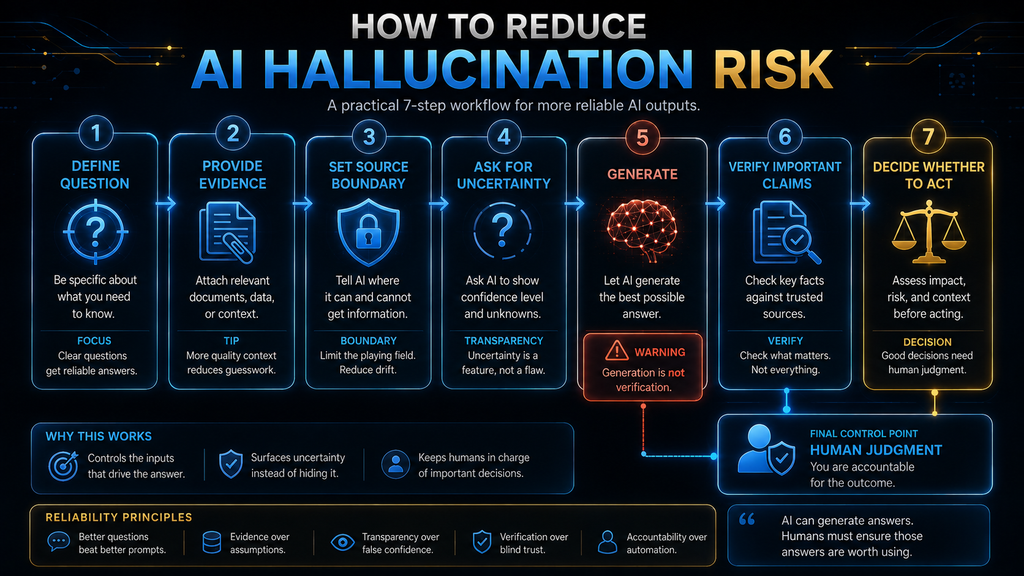
A Simple Hallucination-Reduction Workflow
Use this seven-step process:
1. Define the question
Make the task specific.
2. Supply evidence
Give the AI relevant documents or authoritative sources where appropriate.
3. Constrain the answer
Define what evidence it may use and what it should do if evidence is missing.
4. Ask for uncertainty
Tell it to distinguish known information from inference.
5. Generate
Get the answer.
6. Verify
Check important claims against the actual evidence.
7. Decide
Determine whether the answer is safe to act on. This is more powerful than a generic “verify AI” warning because it gives the reader an actual workflow.
AI Hallucination Risk by Task
| Task | Typical Risk | Recommended Control |
|---|---|---|
| Brainstorming | Low | Human selection |
| Rewriting | Low–medium | Review meaning |
| Summarization | Medium | Compare against source |
| General research | Medium | Source verification |
| Current facts | Medium–high | Search + source check |
| Citation generation | High | Verify every citation |
| Financial analysis | High | Independent evidence |
| Medical guidance | High | Qualified professional + authoritative sources |
| Legal interpretation | High | Qualified professional + primary sources |
| Security decisions | High | Expert verification + testing |
The “Do Nothing” Decision
What happens if you simply assume AI is reliable enough? At first, almost nothing. The workflow seems faster.
Then one incorrect answer gets published. Or one fake citation enters a report. Or one incorrect number reaches a customer.
Or a developer builds around an invented API behavior. The problem with hallucination is therefore not just its average error rate. It is where the errors travel.
A single unverified answer can become: content → decision → automation → system behavior → real-world consequence. The farther an AI output travels without human verification, the more expensive one hallucination can become.
Future of AI Reliability
AI systems are likely to get better at:
- retrieval,
- tool use,
- uncertainty estimation,
- citation,
- reasoning,
- self-checking,
- structured outputs,
- monitoring.
But no single improvement eliminates the need for reliability engineering. The future is therefore not:
Hallucinations disappear.
It is more likely:
AI systems become better at knowing when to answer, when to search, when to use a tool, when to ask for clarification, and when to abstain.
That is a much healthier goal.
Final Thoughts
AI hallucinations are not a strange glitch that occasionally appears when a chatbot has a bad day. They are a deeper reliability problem. AI systems learn powerful statistical patterns.
Those patterns allow them to generate remarkably useful responses. But generating a plausible answer is not the same thing as possessing reliable evidence. And when evaluation systems reward answering more than appropriate uncertainty, models can have incentives to guess.
That is why the right response to hallucinations isn’t:
“Never trust AI.”
It’s also not:
“AI is becoming so advanced that verification no longer matters.”
The more useful position sits between those extremes. Use AI. Ground it.
Constrain it. Ask it to acknowledge uncertainty. Verify important claims.
Scale oversight to the consequences. And remember the central principle:
The best AI system isn’t the one that always has an answer. It’s the one that knows when an answer isn’t justified.
Want to Make Your AI Workflows More Reliable?
Understanding hallucinations is only the first step. Learn how to verify AI information, improve prompts, and build safer AI-assisted workflows.
Learn How to Verify AI Information →Frequently Asked Questions
What is an AI hallucination?
An AI hallucination is a plausible but false or unsupported output produced by an AI system. It can include fabricated facts, citations, people, numbers, quotations or explanations.
Why does AI hallucinate?
Several factors contribute, including statistical prediction, incomplete or low-frequency knowledge, ambiguous requests, missing evidence and evaluation incentives that can reward guessing rather than appropriate uncertainty.
Why does AI sound confident when it is wrong?
Language models are optimized to generate coherent responses, and fluency is not the same as factual certainty. A model can produce a highly polished answer without having reliable evidence for every claim.
Can AI hallucinations be prevented completely?
No guarantee currently exists. Hallucination risk can be reduced through better grounding, retrieval, tool use, prompting, evaluation, abstention, verification and human oversight. Research continues to explore these approaches.
Does RAG eliminate hallucinations?
No. RAG can improve access to relevant evidence, but retrieval errors, conflicting sources and incorrect interpretation can still produce hallucinated or unsupported output.
Do newer AI models hallucinate less?
Many newer models show lower hallucination rates on some evaluations, but hallucinations remain a challenge even for state-of-the-art systems.
Can ChatGPT hallucinate?
Yes. OpenAI explicitly acknowledges that ChatGPT can hallucinate, even though newer models can reduce the frequency of such errors.
How can I reduce AI hallucinations?
Provide relevant source material, define the evidence boundary, ask the AI to acknowledge uncertainty, verify important claims and use stronger controls for high-consequence decisions.
Should I ask AI to “not hallucinate”?
That instruction alone is not enough. A stronger approach is to specify evidence sources, ask for uncertainty and define what the system should do when it lacks sufficient evidence.
Are citations from AI always trustworthy?
No. AI can produce incorrect or fabricated citations. Verify important citations against the original publication or authoritative source.
What is the safest way to use AI for important decisions?
Use AI as an assistance layer rather than the final authority. Ground the task in authoritative information, independently verify consequential claims and keep qualified human judgment in control.
Related Guides
- How to Reduce Hallucinations with RAG: A Practical Guide
- How to Write AI Prompts for More Accurate and Reliable Answers
- How AI Answers Questions: From Prompt to Response Explained
Written by
Muntasir Ahmad Chowdhury
Founder, AI Hustle World
Muntasir Ahmad Chowdhury is the Founder of AI Hustle World, an independent publication dedicated to making Artificial Intelligence practical, trustworthy, and easy to understand. He researches AI tools, automation, customer service, productivity, and real-world business applications, helping readers make smarter technology decisions through research-driven, experience-backed content.
Expertise:
AI Tools • AI Automation • AI Customer Service • AI Productivity • Generative AI • AI Workflows
Get Smarter With AI
Enjoyed this guide? Get practical AI tools, tutorials, and honest reviews delivered to your inbox.
20 thoughts on “Understanding AI Hallucinations: Why AI Gives Wrong Answers”