Updated for late August 2026 with refreshed niche-selection criteria, YouTube AI-content considerations, production-fit analysis, and additional niche validation guidance.
15 Faceless YouTube Channel Niche Ideas
Picking a niche is the step most faceless-channel guides rush past with a bullet list and no context. That’s backwards — the niche you pick determines almost everything downstream: how easy scripting is, which visual format fits, how fast you can post, and whether you’re walking into a monetization risk you didn’t know existed. This article covers all of that: how to actually judge a niche before committing to it, fifteen ideas that genuinely fit a phone-only AI workflow, which niches carry real 2026 monetization risk that most lists don’t mention, and how to test a niche cheaply before you build months of content around it.
If you’ve already read our starter checklist, you know niche selection was flagged there as the first pre-launch decision, ahead of channel setup or tools. This article is the deeper version of that single step — everything else in the checklist assumes you’ve already made this decision, so it’s worth taking the time to get it right before moving forward with the rest of the launch process.
How to Judge a Niche Before You Pick One
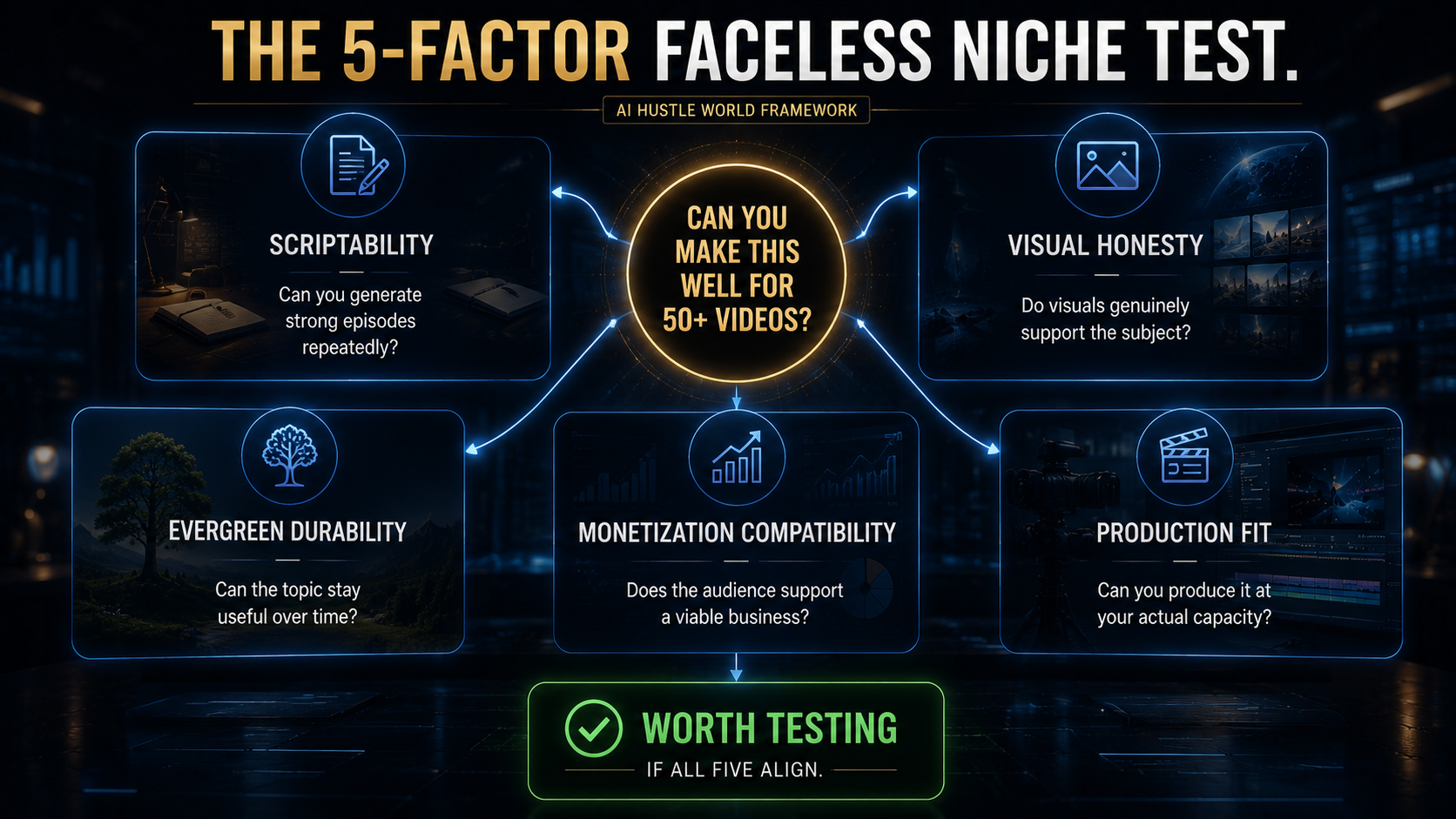
Before the list, it’s worth being explicit about what actually makes a niche work for this format, because “pick something you’re passionate about” is advice that sounds true and helps nobody make an actual decision.
Scriptability:
Can you generate five video topics in this niche in ten minutes without straining? If not, the niche is either too narrow or too thin. Our starter checklist covers this test in more depth if you want the fuller walkthrough.
Visual honesty:
Does the niche’s value come from narration and information, or from watching a specific real thing happen? Niches in the first category work well with AI-generated or stock visuals. Niches in the second — unboxings, real-location travel, hands-on tutorials — need actual footage, and forcing them into a faceless AI workflow produces a worse product than either format done properly. Our tool stack guide breaks down which visual format (stock, avatar, or whiteboard) fits which kind of content, if you want that comparison in full.
Evergreen durability:
Does this topic still matter in two years, or does it expire with a trend cycle? Both can work, but evergreen niches compound — old videos keep earning watch hours long after you’ve stopped thinking about them, while trend-based niches require constant new output just to stay relevant.
Monetization compatibility:
This is the criterion most niche-idea lists skip entirely, and it’s covered in its own section below because it deserves more than a bullet point.
A quick worked example of a niche that fails these tests, since it’s easier to see the framework in action than to take it on faith:
With that framework in mind, here are fifteen niches worth considering.
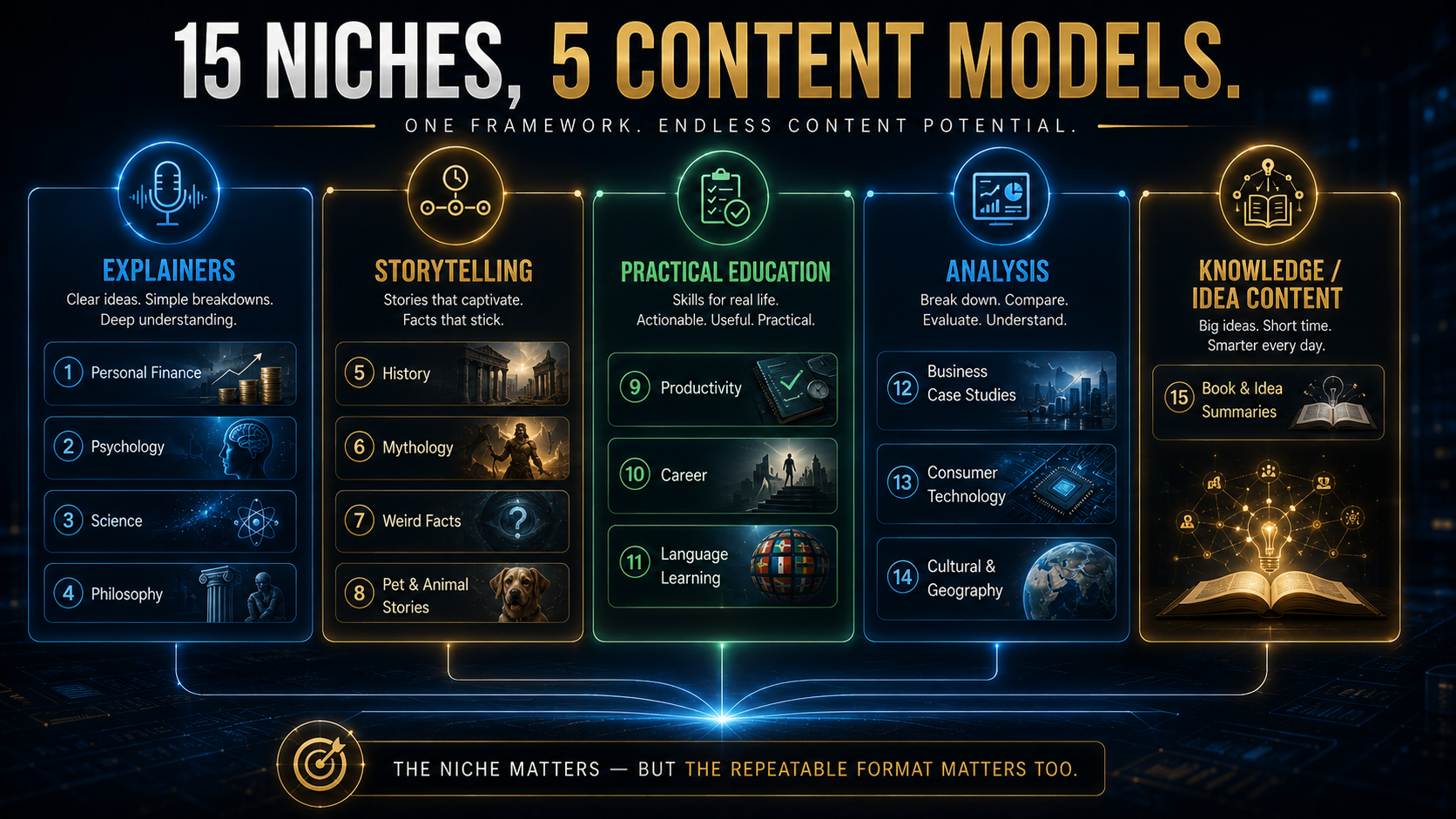
Fifteen Niche Ideas
Explaining budgeting systems, debt-payoff methods, and common money mistakes translates well to narration-driven video, and the audience actively searches for this content. Keep it educational and general rather than framed as personalized advice from an “AI financial expert” — more on why in Part 3. Best format: stock footage with clean graphic overlays for numbers and comparisons. Example topics: “The Debt Snowball vs. Debt Avalanche, Explained,” “Five Budgeting Mistakes That Keep People Broke,” “What a $50,000 Emergency Fund Actually Buys You in Peace of Mind.”
2. History deep-dives on lesser-known events:
Not the most-covered wars and empires — the stranger, less-covered corners of history that don’t already have a dozen big channels dominating the search results. Narration-heavy, visually flexible, and genuinely evergreen. Best format: stock and archival-style footage. Example topics: “The Shortest War in Recorded History,” “The City That Vanished in a Single Night,” “The Forgotten Empire That Rivaled Rome.”
3. Psychology and human-behavior explainers:
Cognitive biases, decision-making patterns, why people behave the way they do in specific situations — this niche has strong search demand and scripts naturally into a hook-driven structure. Best format: stock footage paired with simple on-screen diagrams. Example topics: “Why Smart People Make Predictably Bad Decisions,” “The Bias That Makes You Overestimate Your Own Skill,” “Why We Remember Insults Longer Than Compliments.”
4. Space and science explainers:
Consistently strong watch-time performance across the platform because the visuals (real telescope imagery, simulations) do a lot of the retention work for you. Best format: stock and licensed space-agency footage where available. Example topics: “What Happens to a Human Body in Deep Space,” “The Star That Shouldn’t Exist, According to Physics,” “Why We Haven’t Found Alien Life Yet, Explained Simply.”
5. Mythology and folklore storytelling:
An underused angle compared to history and true crime, with built-in narrative structure that scripts easily and visuals that lean naturally toward illustrated or whiteboard-style animation rather than generic stock clips. Example topics: “The Myth That Predicted Its Own Ending,” “Gods That Different Cultures Invented Independently,” “The Folklore Monster Based on a Real Disease.”
6. Productivity systems and habit-building:
Explaining specific systems (time-blocking, habit stacking, focus techniques) rather than generic motivational content gives you a much larger, more specific pool of video topics than “motivation” alone. Best format: stock footage with clean checklist-style graphics. Example topics: “Why Habit Stacking Works Better Than Willpower,” “The Two-Minute Rule That Fixes Procrastination,” “Time Blocking for People Who Hate Rigid Schedules.”
7. Business case studies and startup failure breakdowns:
Breaking down why a specific company succeeded or failed is a durable, search-friendly format with a near-infinite supply of source material. Best format: stock footage with simple timeline graphics. Example topics: “The $2 Billion Startup That Failed From One Bad Hire,” “How a Failing Product Became a Billion-Dollar Pivot,” “The Business Model Competitors Copied and Still Couldn’t Beat.”
8. Book and idea summaries:
Distilling a book or a body of work into a tight explainer video works well for viewers who want the core ideas without the full read, and it gives you a built-in, never-ending topic pipeline — every new release is a potential video. Best format: stock footage or simple animated text graphics. Example topics: “The One Idea From [Book] Worth Actually Remembering,” “Three Books That Contradict Each Other on the Same Topic,” “The Most Misunderstood Idea in Popular Psychology Books.”
9. Weird facts and trivia:
Lower production ceiling than most niches on this list — short, punchy, list-style videos with a huge topic pool, though the ceiling on depth and audience loyalty is also lower than more substantial explainer formats. Good for testing the workflow itself before committing to a deeper niche. Example topics: “10 Facts That Sound Fake But Are True,” “The Everyday Object With a Bizarre Origin Story,” “Numbers That Don’t Make Sense Until You See Them Visualized.”
10. Philosophy made simple:
Explaining philosophical ideas and thought experiments in plain language is underserved relative to how much search demand exists for “meaning of life”-adjacent content. Best format: stock and abstract visual footage, or whiteboard-style for diagramming ideas. Example topics: “The Thought Experiment That Breaks Your Sense of Identity,” “Why Ancient Philosophers Already Solved Your Modern Problem,” “The Paradox That Has No Good Answer.”
11. Career and job-search explainers:
Resume mistakes, interview preparation, and career-change guidance are consistently searched topics with clear practical value. Frame this as general education on common patterns rather than one-on-one personalized coaching from an AI “expert,” for the same reason covered in Part 3. Best format: stock office/workplace footage. Example topics: “The Resume Mistake That Gets You Filtered Out in Seconds,” “Why Qualified Candidates Still Get Rejected,” “The Interview Question That’s Actually a Trap.”
12. Language-learning tips and techniques:
Explaining learning methods, common mistakes, and memory techniques (rather than teaching a specific language directly, which usually needs a fluent presenter) fits the faceless format well and travels across multiple audience segments. Example topics: “Why Adults Learn Languages Differently Than Kids,” “The Memory Technique Polyglots Actually Use,” “Common Mistakes That Keep Learners Stuck at Intermediate.”
13. “What it’s like” cultural and geography explainers:
Life in a specific country, city, or region — cost of living, culture, daily routines — told through narration and licensed stock or travel footage rather than firsthand filming. Best format: stock location footage. Example topics: “What $1,000 a Month Actually Buys in [City],” “The Everyday Habit That Surprises Foreign Visitors,” “Why This Country’s Education System Gets Copied Worldwide.”
14. Social psychology and relationship dynamics:
How relationships and social dynamics actually work, from a research and pattern-recognition angle rather than personal advice-column framing. Keeps a safe distance from anything that reads as one-on-one counseling. Best format: stock footage with simple relationship-dynamic diagrams. Example topics: “The Communication Pattern That Predicts Relationship Success,” “Why Familiarity Breeds Both Comfort and Conflict,” “The Research-Backed Reason First Impressions Are Wrong.”
15. Pet care and animal facts:
Consistently strong-performing content category on the platform, with a wide topic pool (species facts, care guides, behavior explanations) and low sensitivity risk compared to most niches on this list. Best format: stock and licensed animal footage. Example topics: “Why Your Dog Actually Tilts Its Head at You,” “The Common Pet Care Myth Vets Wish Would Die,” “Animals With Senses Humans Can’t Even Imagine.”
A Different Kind of Risk: Niches That Look Easy But Are Already Crowded
Monetization risk (covered next) isn’t the only thing worth watching for — competitive saturation is a separate problem, and it’s easy to confuse the two. A niche can be perfectly safe from a policy standpoint and still be a poor choice because a handful of established channels already dominate its search results with a multi-year head start. “AI news and updates,” general motivational-quote channels, and generic “top 10 movies” content all fall into this category: nothing wrong with them policy-wise, but the competitive bar to rank or get recommended against existing giants is considerably higher than in most of the fifteen niches above, which were deliberately chosen partly because they’re not the most oversaturated corner of their broader category (lesser-known history instead of major wars, underused mythology instead of true crime, general productivity systems instead of generic motivation).
The practical test: search your candidate niche on YouTube directly and look at how many of the top-ranking results are from channels with a subscriber count and video library that would take you a year or more to match. A few strong incumbents is normal and fine. A search results page saturated top to bottom with channels that have been at this for years is a signal to narrow your angle further or pick a different niche from this list.
Five More Niche Ideas Worth Considering
If none of the fifteen above feel like the right fit, here are five more that pass the same four-part test from Part 1, kept brief since the core evaluation criteria and format guidance already apply to each.
Nutrition science myth-busting:
Explaining what current research actually says about common food and diet claims, framed strictly as research summary rather than personal dietary guidance. Best format: stock footage with simple comparison graphics. Example topics: “What the Research Actually Says About Skipping Breakfast,” “The Diet Myth That Won’t Die Despite the Evidence.”
Ancient civilizations and archaeology:
Overlaps with history but distinct enough in audience and content style to stand alone — new discoveries provide a steady stream of fresh topics beyond what’s already been covered. Best format: stock and archival-style footage. Example topics: “The Ancient City Engineers Still Can’t Fully Explain,” “A Recent Discovery That Rewrote a Textbook Timeline.”
True stories and narrative writing prompts:
Anonymized, fictionalized short narrative content in a similar vein to community-story formats, clearly labeled as written/fictional rather than presented as real events, which sidesteps the authenticity risk covered in Part 3. Best format: stock footage or simple illustrated visuals. Example topics: “A Short Story About the Stranger Who Changed Everything,” “Fiction: The Note Left Behind.”
Consumer technology explainers:
How specific everyday technologies actually work under the hood — not reviews of specific products, which requires real hands-on use, but explanations of the underlying tech. Best format: stock and simple diagram visuals. Example topics: “How Your Phone Actually Knows Your Location,” “The Technology Behind Noise-Cancelling Headphones, Explained.”
Logical fallacies and critical thinking:
Explaining common reasoning errors and how to spot them in everyday arguments and media. Adjacent to the psychology niche above but distinct enough in framing to support its own channel if psychology alone feels too broad. Best format: stock footage with simple example-based graphics. Example topics: “The Argument Trick That Sounds Convincing But Isn’t,” “Why This Common Debate Tactic Fools Smart People.”
How Niche Choice Affects Your Production Speed
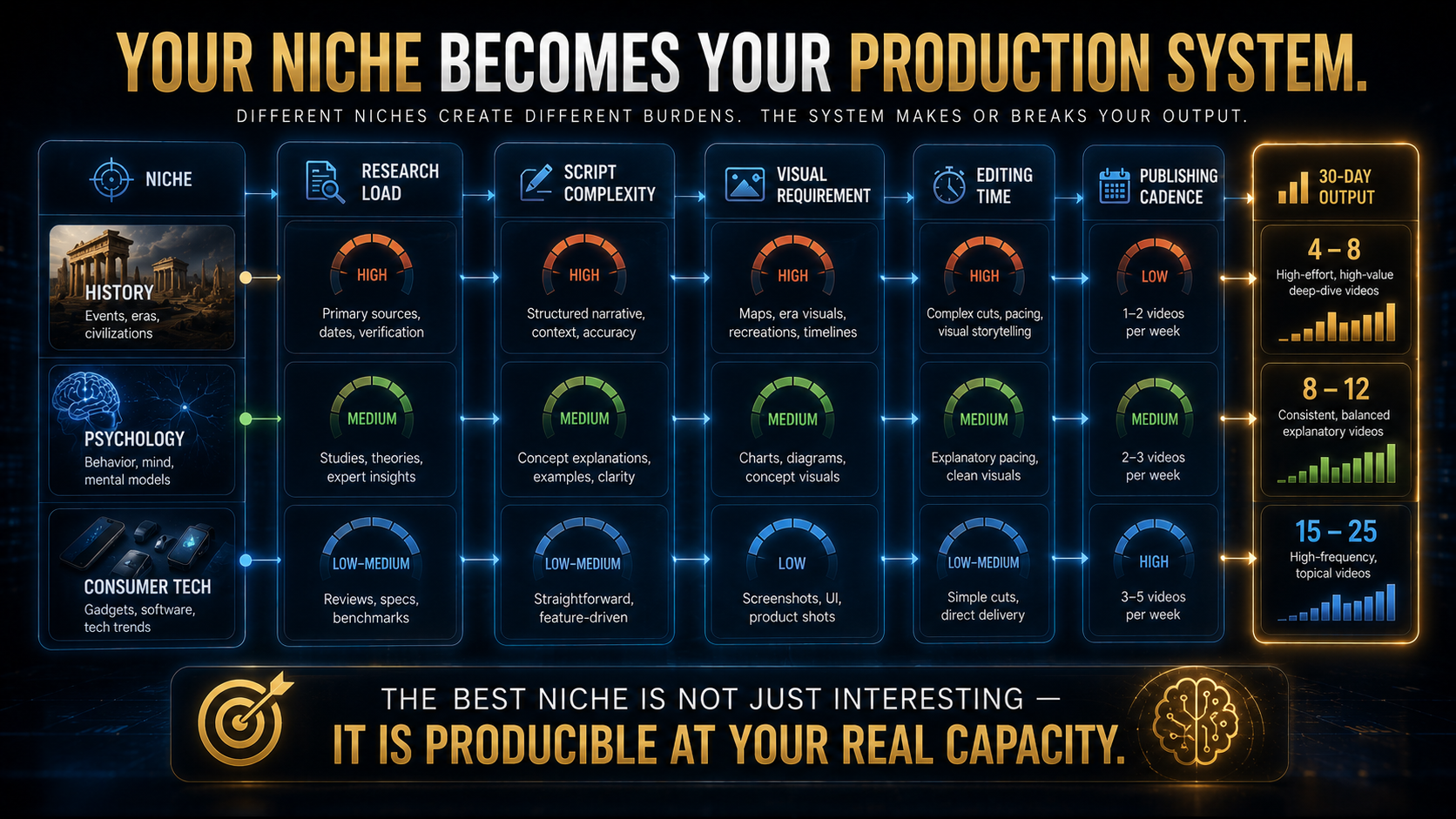
Not all fifteen niches above take the same amount of time to produce, and it’s worth choosing with your realistic posting cadence in mind, not just topic appeal. Fact-heavy, research-driven niches — history, space and science, business case studies — take longer per video because the script depends on getting details right, which means more time verifying claims before you narrate them. List-style and trivia-driven niches move faster because each segment is short and self-contained, which is part of why trivia is a reasonable first niche to test your workflow with even if you don’t plan to stay in it long-term. Storytelling-driven niches like mythology sit in between — the narrative structure makes scripting faster once you have a template, but a weak structure is more noticeable to viewers than in a straightforward list format.
If your realistic capacity is genuinely two videos a week per our starter checklist, a heavier research niche is still workable — it just means your first month may only support your committed cadence if you batch research a week ahead rather than researching and scripting the same day you publish.
Repurposing One Niche Across Pinterest and Shorts
Every niche on this list produces content that repurposes naturally into other formats, which matters if you’re running a Pinterest strategy alongside your channel the way we are. A single history or psychology video’s script typically contains three to five standalone facts or claims strong enough to become individual Pinterest pins or YouTube Shorts on their own, each pointing back to the full video. Trivia and weird-facts content repurposes the most easily of all fifteen niches — nearly every line is already a self-contained, pinnable moment — while narrative-driven niches like mythology repurpose less cleanly, since a story loses meaning pulled out of sequence. If cross-platform repurposing is a priority for you, that’s a real factor in favor of the list-style and fact-driven niches (trivia, space facts, psychology) over the more narrative ones, independent of which topic interests you more personally.
Naming Your Channel to Match Your Niche
Once you’ve settled on a niche, the channel name should signal it clearly rather than leaning on a clever but ambiguous brand name your audience has to learn the meaning of. A history channel called something evocative but vague competes worse in search and recommendations than one whose name makes the content obvious at a glance. This matters more for faceless channels specifically, since there’s no recognizable face to carry brand recognition while a viewer figures out what the name means — the name and the thumbnail are doing all of that work alone. If you’re genuinely torn between a clever name and a descriptive one, lean descriptive for at least the first few months, since search and recommendation algorithms both reward clarity early on, before you have enough brand recognition for a cleverer name to pay off on its own.
Mixing Formats Within One Niche
Every niche above supports more than one video format, and mixing them keeps a channel from feeling repetitive even within a narrow topic. A psychology channel, for instance, can alternate between single-concept deep-dives (“The One Bias That Explains Most Bad Financial Decisions”), list-style roundups (“Five Cognitive Biases You’ve Definitely Fallen For”), and lighter Q&A-style videos answering a specific viewer question. This variety does two things: it keeps your own production process from feeling monotonous, which matters for a cadence you need to sustain past month one, and it gives you multiple entry points for new viewers who might not click on a deep-dive but would click on a punchier list format. Pick one niche, but don’t feel locked into one video structure within it.
Niches to Approach With Real Caution in 2026
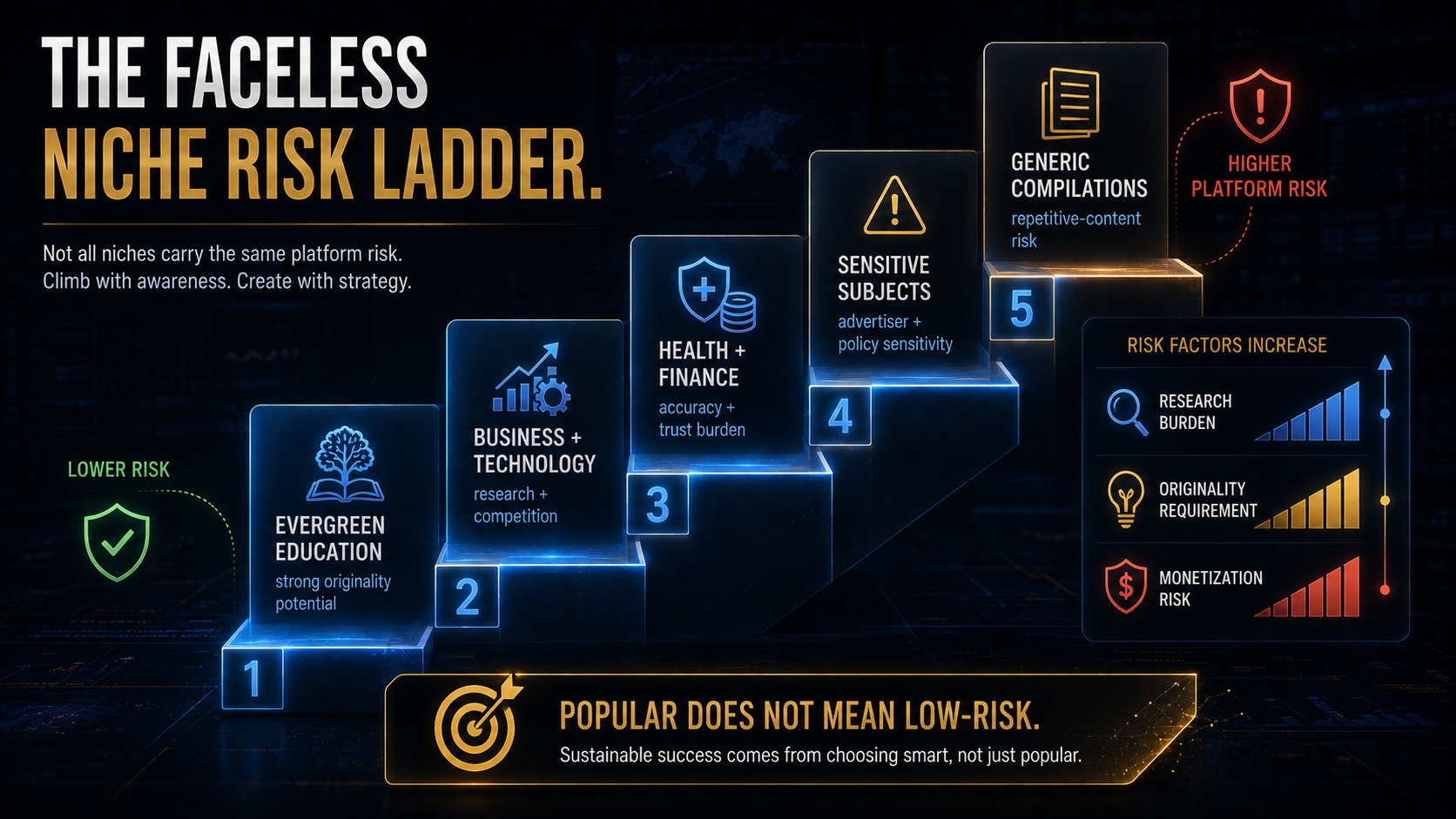
This is the section most niche-idea guides leave out entirely, and it matters more this year than in the past. According to YouTube’s own monetization policy page, content is explicitly ineligible for monetization when it presents an AI-generated persona as a human expert giving advice on sensitive topics — the policy names health, legal, financial, and political advice specifically. This isn’t a ban on covering these topics faceless; it’s a ban on presenting an AI voice as if it were a credentialed advisor speaking directly to a viewer’s personal situation.
True crime deserves its own warning beyond that. Multiple 2026 reports describe channels — including ones with established subscriber counts — losing monetization or being removed entirely after publishing AI-generated true-crime narration, particularly when cases involved real victims. YouTube has specifically targeted AI content that “realistically simulates” deceased individuals or crime victims. If true crime genuinely interests you as a niche, the safer path is heavy original research and commentary with your own analysis driving the video, not AI-generated dramatized narration of a real case — and even then, expect closer scrutiny and a higher chance of limited ads than the niches listed above.
Health and wellness advice framed as coming from an expert is similarly risky if the channel presents itself, even implicitly, as a source of medical guidance rather than general education. Niche #1 above (personal finance) and #11 (career advice) carry a lighter version of this same risk — the fix in all three cases is the same: frame content as explaining patterns and general information, never as personalized advice from an authoritative persona, and be transparent that the channel isn’t a substitute for a licensed professional.
Commentary on current events involving conflict or controversy is a third category worth naming, even though none of the fifteen niches above touch it directly. Creators covering geopolitical events, even with measured and balanced framing, have reported automated flags purely from keywords associated with violence or controversy, regardless of editorial stance. This isn’t a reason to avoid current events entirely, but it’s a reason to expect inconsistent ad performance if you build a channel primarily around them, and it’s part of why none of the fifteen recommended niches above lean on breaking news or active controversies as their core format — evergreen topics are both easier to script consistently and safer from a monetization-consistency standpoint.
None of this means avoid these topics entirely — it means know the framing risk going in, rather than discovering it after a channel gets flagged.
What Creators Wish They’d Known Before Picking Their Niche
A pattern worth naming explicitly, since it comes up often enough to matter: the regret most creators report isn’t picking the “wrong” topic in some absolute sense — it’s picking a niche based on how exciting it felt to think about rather than how sustainable it felt to actually produce, week after week, once the novelty wore off. A niche that sounds impressive to describe to other people isn’t the same thing as one that’s easy to keep generating fresh scripts for six months in. The four-part test in Part 1 exists specifically to separate these two things, because they’re easy to confuse when you’re excited about starting something new.
The second common regret is choosing a niche in isolation from the practical realities covered in this article — production speed, repurposing potential, and monetization framing — and only discovering the mismatch after a month of videos. That’s exactly why Parts 2 through 4 exist as more than a simple list: matching your niche to your actual constraints, not just your interests, is what separates a channel that’s still posting in month six from one that’s quietly stopped.
Part 4 — Testing a Niche Before You Commit
Don’t pick a niche and build fifty videos of runway before finding out it doesn’t work. A cheap, fast test: produce three videos in a candidate niche using your existing stack, publish them, and give it two to three weeks. Look specifically at retention in the first fifteen seconds (a niche-fit problem shows up as a steep early drop across all three videos, not just one) and at how easily you generated the next five video topics after publishing the first three. A niche that’s genuinely thin reveals itself here — you’ll find yourself straining for the sixth or seventh topic idea in a way you didn’t for the first five.
If two of your three test videos hold retention reasonably well and topic ideas keep coming easily, that’s a strong signal to commit further. If you’re fighting for every script and retention is weak across the board, that’s cheaper information at three videos than at thirty.
To make “hold retention reasonably well” concrete: you’re looking for a graph that doesn’t fall off a cliff in the first fifteen seconds and that still has a meaningful chunk of viewers remaining at the halfway mark, compared side by side across your three test videos. You’re not benchmarking against other channels at this stage — you don’t have enough data for that comparison to mean anything yet — you’re comparing your own three videos against each other to see whether the niche itself, independent of your still-improving production skill, seems to hold attention.
One more genuinely useful move: niche combination. Several of the fifteen ideas above pair naturally — psychology plus relationship dynamics, history plus mythology, business case studies plus career advice. A combined niche narrows your positioning (“psychology of career decisions” instead of two separate broad topics) while still giving you two source pools to draw video ideas from, which solves the “running out of ideas” problem that kills thinner single-topic niches faster.
A few worked combinations to make this concrete: “Psychology of Money” merges niche #1 and #3 — every behavioral-finance topic (why people overspend, why saving feels harder than it should) becomes a video, drawing from both a psychology angle and a finance angle without tipping into personalized financial advice. “History’s Business Lessons” merges #2 and #7 — historical events reframed through a business-strategy lens, which sidesteps the saturation problem of pure business-case-study channels while staying just as evergreen. “The Philosophy of Habits” merges #6 and #10 — habit-building content grounded in philosophical framing rather than generic productivity-hack framing, which is a genuinely underused angle relative to how crowded plain productivity content has become.
Quick Reference: All 15 Niches at a Glance
| Niche | Best Format | Production Speed | Repurposing Ease |
|---|---|---|---|
| Personal finance | Stock + graphics | Medium | High |
| History deep-dives | Stock/archival | Slow (research-heavy) | Medium |
| Psychology explainers | Stock + diagrams | Medium | High |
| Space & science | Stock/licensed | Medium | High |
| Mythology & folklore | Illustrated/whiteboard | Medium | Low |
| Productivity systems | Stock + checklists | Fast | High |
| Business case studies | Stock + timelines | Slow (research-heavy) | Medium |
| Book & idea summaries | Stock/animated text | Medium | Medium |
| Weird facts & trivia | Stock | Fast | Very High |
| Philosophy made simple | Stock/whiteboard | Medium | Medium |
| Career explainers | Stock (office) | Medium | High |
| Language-learning tips | Stock | Medium | Medium |
| “What it’s like” culture | Stock (location) | Medium | Medium |
| Relationship psychology | Stock + diagrams | Medium | Medium |
| Pet care & animal facts | Stock/licensed | Fast | High |
Use this alongside Part 1’s four-part test, not instead of it — the table tells you the practical tradeoffs; the test tells you whether the niche fits you specifically.
FAQ
Is true crime a bad niche for a faceless channel?
Not automatically off-limits, but it carries real 2026 monetization risk, especially for AI-generated dramatized narration of real cases. If you pursue it, lean on original research and your own commentary rather than AI-narrated dramatization, and expect closer scrutiny than lower-risk niches.
Can I give financial or health advice on a faceless channel?
You can cover finance and health topics, but not as personalized advice delivered by an AI persona presented as an expert — that’s explicitly ineligible for monetization under YouTube’s policy. Frame this content as general education instead.
How many video ideas should I be able to generate before committing to a niche?
At least five within about ten minutes of brainstorming, per the scriptability test in Part 1. If that’s a struggle, the niche is likely too narrow or too thin to sustain a channel long-term.
What’s the fastest way to test whether a niche will actually work?
Publish three videos and watch first-15-second retention and how easily follow-up topic ideas come to you. Both are visible within two to three weeks, well before you’ve invested months into a niche that isn’t working.
Can I combine two niches from this list?
Yes, and it’s often a stronger choice than either alone — a combined niche narrows your positioning while giving you two idea pools instead of one, which helps you avoid running out of topics.
Does niche choice affect how often I can realistically post?
Yes. Research-heavy niches like history or business case studies take longer to script accurately than list-style or trivia content, so a heavier niche may require batching research ahead of time to sustain a twice-a-week cadence.
Which niche repurposes best into Pinterest pins or Shorts?
Fact-driven, list-style niches like trivia, space facts, and psychology repurpose most easily, since individual facts stand alone as pins or Shorts. Narrative-driven niches like mythology repurpose less cleanly, since a story loses meaning pulled out of sequence.
How do I know if a niche is already too saturated to enter?
Search the niche directly on YouTube and check how many top-ranking results come from channels with years of head start and large existing libraries. A page dominated by long-established channels is a signal to narrow your angle or choose a different niche.
What’s the most common regret creators have about their niche choice?
Picking a topic based on how exciting it sounded rather than how sustainable it felt to produce week after week. Running a candidate niche through the four-part test in Part 1 before committing helps catch this before months are spent on it.
Should I pick a niche I’m personally passionate about?
Personal interest helps you stay motivated, but it isn’t a substitute for the scriptability, visual-honesty, evergreen, and monetization tests in Part 1. A niche that passes those tests and interests you moderately tends to outlast one you love but that fails them.
Final Thoughts
The niche you pick shapes everything downstream — how easy scripting is, which tools fit, how fast you can post, and whether you’re walking into monetization risk you didn’t see coming. Run the scriptability and visual-honesty tests from Part 1 before you fall in love with an idea, take the caution section in Part 3 seriously rather than finding out the hard way, and test cheaply with three videos before committing months to a single topic.
Two things are worth remembering after you’ve made a choice. First, saturation and monetization risk are separate problems — a niche can fail either test independently, so check both rather than assuming one clears the other. Second, your posting cadence and repurposing plans are just as much a part of “picking a niche” as the topic itself; a niche that fits your interests but fights your realistic production speed will wear you down faster than one that’s slightly less exciting but genuinely sustainable.
Once you’ve picked a direction, the starter checklist and the tool stack guide cover everything else you need to actually launch.
Want the Full Checklist to Build Your Faceless Channel?
Get our free Faceless Channel Starter Checklist with the essential tool pairing, first-week posting plan, and the mistakes that can waste your time during month one.
Get the Free Checklist →Written by
Muntasir Ahmad Chowdhury
Founder, AI Hustle World
Muntasir Ahmad Chowdhury is the Founder of AI Hustle World, an independent publication dedicated to making Artificial Intelligence practical, trustworthy, and easy to understand. He researches AI tools, automation, customer service, productivity, and real-world business applications, helping readers make smarter technology decisions through research-driven, experience-backed content.
Expertise:
AI Tools • AI Automation • AI Customer Service • AI Productivity • Generative AI • AI Workflows
Get Smarter With AI
Enjoyed this guide? Get practical AI tools, tutorials, and honest reviews delivered to your inbox.
4 thoughts on “15 Faceless YouTube Channel Niche Ideas That Actually Work in 2026”